Friday, 18 August 2017

Choosing to have my treatment at The Christie was the best decision I ever made - Esther Parkinson

Esther Parkinson, Christie patient and fundraiser

Esther Parkinson
I was diagnosed with breast cancer in September 2013. It’s a date that will always stick in my mind, and sometimes still feels like yesterday. Diagnosis day was a very dark day. 

Anyone who has been affected by cancer, directly or indirectly will know the impact it has on your life. Not just yours but others around you too. It turns your world upside down and rips up the rule book on emotions and how you should feel. You don’t know where to put yourself, what to do, what to say, whether to cry, whether to shout etc. It sends your head completely into a spin.

I was diagnosed at my local hospital in Blackpool. At the time, my mum and my sister were with me when I received the news.  We went home that day, very quiet and caught up in our own thoughts. 

Fortunately for me, my sister is a consultant oncologist (in Cambridge) and a few days later, she recommended The Christie as a place to have my treatment. Although I’d vaguely heard of The Christie, I wasn’t aware of its renowned reputation and the brilliant work it does. So for me, I was weighing up having my treatment just 15 minutes down the road in Blackpool, versus travelling more than an hour each way to Manchester every time. 

My head was still scrambled at that point, as I was still trying to deal with the news of my diagnosis. So in my eyes, the less travel involved, the better - especially if I was feeling unwell due to the treatment. I wasn’t focusing on the important bit, which was where would be the best place to have treatment.

Lengthy discussions took place with my sister, and thankfully she put her foot down and insisted that I go to The Christie. She explained all the reasons why and highlighted that it was a specialist cancer hospital and was not only the number one hospital in the North West, but the best in the country. I couldn’t really argue against that, so I agreed to go The Christie. 

It was the best decision I was ever to make. 

Upon walking through the doors of The Christie, it instantly feels welcoming and has a friendly feel that I’ve never experienced in any other hospital. 

All the professionals and staff always make you feel like an individual, they genuinely want to help you get better, and help make the journey as stress-free as possible. They are obviously aware that you are going through a traumatic time, and there is always someone to speak to or hold your hand (physically as well as metaphorically). 

I have a phobia of needles, and the very sight of one (and even talking about it at times) sends me white and wobbly! Apart from the obvious diagnosis, having to have treatment intravenously was my worst nightmare come true, not to mention all the blood tests required. They all involved a dreaded needle. It was just unthinkable, and I had no way of getting past how I would cope. 

On my first treatment day, I mentioned my phobia to the chemo team and they made a referral there and then to the complementary therapies team. Within about half an hour someone came to see me, and started talking me through some cognitive behavioural therapy techniques and ways to try to relax to cope with the forthcoming treatment. They were extremely helpful and patient with me, and although stress levels were still quite high, they had reduced somewhat by the time it came to chemo time. 

On the following treatment day, I was visited once again by the complementary therapies team, and again they talked me through some more relaxation techniques. This time they gave me an aromatherapy stick to sniff (a bit like a Vicks inhaler but with aromatherapy vapours) when I was feeling anxious, and explained how to associate this with pleasant experiences and happy times. This proved to be a successful technique and helped make the treatment a calmer experience for me.

The following few treatments I learnt to cope without help from staff, using the techniques I had been shown together with the aromatherapy stick. It was a genius invention but such a simple one too. As my treatments were coming to an end, I was just about managing my phobia. What started out as something I couldn’t even comprehend going through, ended up being something I could just about cope with, without passing out!! This is thanks to the wonderful help of the complementary therapies team. 

My penultimate treatment was on Christmas Eve. I had mixed feelings about coming in the day before Christmas. But actually, it turned out to be a really lovely day. The staff were very upbeat, with their Christmas hats on, and it was a positive place to be (as it always is). I remember being offered a foot massage that day, which I happily accepted, and treated it as a little Christmas present! This was another marvellous relaxation technique and I pretty much sailed through my chemo that day. Another one ticked off the list and without any dramas too. 


Christie charity fundraisers David and Esther
I can’t fault any of the staff at The Christie. All the nurses were brilliant with me. They were always very approachable and introduced themselves at all times. They had a great bedside manner, offered advice when needed and listened to me whenever I had any questions about my treatment. Most of all, they treated me like a normal human being, and not just a number. They would happily chat with me about everyday stuff, whilst carrying out their duties and looking after me.

Everyone at The Christie is fabulous, from the volunteers, to the porters, to the nurses, to the doctors and the administration staff. There is always a smile on a face and a helping hand whenever it’s needed. 

The Christie has never felt like a hospital to me. As many people have said before – it’s like a second home - and I will always be comfortable visiting the place. The corridors are filled with positivity, despite so much illness being around. 

It just goes to show that The Christie is a place that really does care, discover and teach.


Monday, 7 August 2017

My Blip - Kaye Sawyer

Kaye Sawyer, Christie mobile chemotherapy service patient 

Kaye Sawyer
In 2012 my mum was diagnosed with stage 3 aggressive breast cancer. Aged 71 and still with everything to live for, she didn’t give it the time of day! Mastectomy, chemo and radiotherapy, she held her head high and punched the cancer in the face. Fast forward four years and it was my turn.

Diagnosed in February 2016 with stage 3 invasive breast cancer and HER2 positive I only had one option and that was to give it what for, just like my mum. I was ready, I knew what was coming and I was going to be just like her, head held high and smiling my way through.

So, after all the appointments and checks, I had my left breast removed BUT had a reconstruction at the same time; I was going under with one and I was coming out with one regardless. I was advised there could be slight complications with the implant and my skin may become tighter after the radiotherapy but hey ho, I’ll meet that if or when it happens.

With surgery a success I was on to chemotherapy, slightly delayed as I wanted to go on a weekend away, and why not? My life’s for living regardless, I will do the things that I can while I can. Punch number 1 done and dusted! 

After a weekend away with my fab colleagues, I began the chemo. My hair began to fall out after the first session but I had short hair anyway and after three sessions I was completely bald. I had the caps and scarves but they didn’t really suit me. I wore one for work once and one of my friends asked me to cross their palm with silver! (It was funny at the time). But knowing I would have no hair I had decided prior to all this to re-invent myself so I had got myself a long-haired wig. I loved it - it was my costume, it was my confidence and it quite suited me (I think!). There were moments of sadness through all this, but not for long.

The Herceptin was introduced to my last three chemo sessions plus the chemo drugs were changed. I had a concoction of madness that put me to bed for a couple of days but only to watch TV and chill out and it was on a weekend so really wasn’t a big deal for me.

I had my chemotherapy nearer to home at the Churchill unit in Bolton. This was far more convenient for me as I had my bloods checked on the way to work on a Tuesday, chemo on the Wednesday and then back in work on Thursday. That’s right, punch number 2, I worked my cancer treatment around my work not the other way around.

I had 18 Herceptin injections to get through (one every 3 weeks) and I was given the choice of The Christie’s mobile unit situated just five minutes from work, in Tesco’s car park to be precise!

I couldn’t believe I was rocking up to a car park to get lifesaving treatment but it is amazing. 

On approach, it’s a big van but on the inside it’s like a Tardis! I have been there every three weeks since September 2016 and I can honestly say it doesn’t feel like I am being treated for cancer at all. Plus, I can nip into the supermarket when I need to and get back to work in plenty of time.

The staff are fabulous of course and I have made really good friends there. We talk about everyday things and as women we chat about hair, make up and nails, swapping tips and truthfully having a good coffee morning! And I was delighted to be part of BBC Radio 5 live’s day of broadcasts from The Christie a few weeks ago, talking about the friends I’d made on the mobile unit.

It’s hard to believe that treatment/chemo is being given when we are all sitting there smiling but that’s the beauty of the chemo bus. There isn’t any waiting around, or walking along corridors and trying to find your way around and feeling nervous as hell. In fact, most ladies I meet here come on their own, it’s that easy.

My radiotherapy started last October, three weeks of going every day and was done at The Christie at Salford, part of Salford Royal Hospital, two minutes away from work so I went there on my lunch break. Punch number 3, I am nearly there!

I had my last Herceptin injection in July 2017. My road will end at the mobile unit but my life will carry on with (in a weird way) good memories of the beautiful people I have met along the way and a few good pictures of me with long hair!

I am only 47. My son Ashley has recently got engaged to his gorgeous girlfriend Abby. My mum is on her last year of medication, Letrozole, and both she and my dad live with me, we take care of each other and now we have a wedding to plan!

My family and friends think I am brave, an inspiration. I just think I have another funny story to tell, it’s called my blip!

Just remember that before that knockout punch you need to ask a lot of questions about the nearest treatment facilities for you, because that’s half the job done. It’s tough enough without the stress of traffic, car parking, who’s taking you, who’s picking you up and what you need to take to keep you occupied throughout the day.

You need all the strength you can get.  Each facility I have been to, for each stage I’ve been through, has been small, intimate and friendly and I have never spent all day waiting anywhere. But the best thing is, I hardly ever felt like I had cancer!  My last words of wisdom will be, rest when you need to, enjoy when you can and listen to your body. Most importantly don’t let the damn thing change you. We all have blips.

IN YOUR FACE CANCER!

You can hear Kaye on BBC Radio 5 live at https://youtu.be/u5MJrj4OBqY

To find out more about our mobile chemotherapy service please visit www.christie.nhs.uk/patients-and-visitors/your-treatment-and-care/our-treatment-centres/mobile-chemotherapy-unit/


Tuesday, 25 July 2017

I feel extremely privileged to support the patients who take the brave step to participate in clinical trials - Sam Corlett

Sam Corlett, clinical research nurse in the Melanoma team 

Sam Corlett
As a clinical research nurse I’ve often been asked what my role is and what a typical day involves. Firstly, there is no such thing as a typical day as a research nurse. The main focus of my role is to ensure the safety of the patients who are taking part in a clinical trial using a new drug treatment. 

My colleagues and I support the patients from the moment they are asked to consider a clinical trial to the point in time when they have completed the study for whatever reason that may be. 

Patients can ask for, or are asked to consider clinical trials at various times throughout their treatment; this could be at diagnosis or after other treatments have stopped working. I get involved at the very beginning by discussing the study with the patient and give them a patient information sheet which has full details of what to expect if they enter a clinical trial. 

Sometimes this happens in the clinic or it can be done via telephone after the consultation, but it is often both; it is important to ensure the patient does not feel coerced at all. 

My role is to ensure they receive all the information they need to make an informed choice about the best treatment path for them. This means I need to have knowledge of not just the trial protocol but also the treatment they would receive if not on a trial. There is no limit to a number of questions I get asked and what is important to one patient may be different to the next patient.    

Once a patient has made a decision to enter a clinical trial I plan with them the next steps. 

These include various screening tests such as scans and blood tests that we do at The Christie and sometimes tests at other hospitals, for example eye tests. This can take a lot of co-ordinating to ensure the least number of visits for the patient. I am constantly keeping the patient informed of what is happening, for example the results of tests.

Screening is done to ensure the patient is eligible for the trial and to ensure that they can receive the trial drugs safely. Not all patients who consent to a trial enter one, they may have a blood test out of allowable range for example, which means they cannot enter a trial. 

Managing their disappointment when this happens can be challenging, especially if they have come to The Christie specifically for a particular trial. 

As a centre specialising in melanoma treatments, patients can come from far and wide. 

From the outset, I ensure they are aware that being considered for and consenting to a clinical trial is no guarantee that they will receive treatment. 

Communication is essential in my role, not just with the patients but with all the departments that support research at The Christie. I work closely with the radiology team to request scans and with the pharmacy team to ensure they have the drugs required and that the prescription is ready.

When all the checks have been done and a patient accepted onto a trial, I then schedule the patient for their treatment. This might be in our dedicated clinical research facility or in the main chemotherapy unit depending on the treatment. The Christie has a strong research culture which is evident throughout the organisation, within all the different departments. 

As many of the trial drugs and treatments are new, not all the nurses at The Christie know how to administer them, how they work, or what the side effects are. That’s why I am also a nurse educator. I use my specialist knowledge of the trial drug to help other nurses in the Trust learn about them.  

Being a clinical research nurse in melanoma has increased my knowledge not just of melanoma as a disease and how we treat it but also how new treatments are introduced into the NHS. 

The mantra of a clinical research nurse is ‘If it isn’t written down then it didn’t happen!’ which means paperwork – lots and lots of paperwork. 

I’m sure most readers have seen the annoying piece of paper that often gets in the way in a packet of paracetamol. Until I became a clinical research nurse I never realised where that came from. All the toxicities the patient experiences are documented, along with every drug they are taking both before during and after taking part in the clinical trial. This information is entered into databases by every hospital taking part in the clinical trial across the globe and once a drug becomes licensed that information becomes the annoying piece of paper in the drug packet. 

Reviewing the patient with the medical staff at every visit to the hospital means I can ask how they are feeling and what symptoms they have had, any new drugs they have taken and ensure that they know how to manage side effects in order that they maintain a good quality of life. This means we have collected the information required for the clinical trial and this can be entered into the database by the clinical research administrator with whom I work really closely. 

Being in a consultation with a patient when they hear good news, like a scan showing that the treatment is working, is an honour. But along with the highs come the lows. It’s all part of my job to support patients and their families when the treatment is no longer working. This is difficult and never gets any easier, particularly if I’ve known the patient for months or even years!  

Any patient taking part in a clinical trial is taking a leap into the unknown; it is a trial because we need to find out if the drug is more effective than existing treatments. Although many patients hope they will benefit personally from the trial, many are also doing it for altruistic reasons in the hope that other people after them will benefit from the research. 

As a research nurse I feel extremely privileged to support the patients who take the brave step to participate in clinical trials and helping them through the decision making process to the end of the trial.

Any patients who are suitable for a clinical trial may be approached by their clinician or a research nurse to discuss a study. Patients can also ask their clinical team at any point if there are any trials they may be eligible for. Anyone with a general enquiry about clinical trials at The Christie can email informationcentre@christie.nhs.uk 

Thursday, 13 July 2017

A second chance - Julie Scates

Julie Scates, Christie patient

Julie Scates
In March 2014 I was 39 and my big birthday was approaching. My partner Steve and I had lots of great plans, but little did I know that a terminal primary peritoneal cancer that had spread to my ovaries, liver, bowels, diaphragm and omentum (the layer of peritoneum that surrounds abdominal organs) was going to thwart those plans and change my life forever.  

I am from Belfast in Northern Ireland and live there with Steve and three children now aged 24, 18 and 13. I always had a hectic family and work schedule up to Nov 2013 when my health deteriorated.  

I was classically misdiagnosed with irritable bowel syndrome and then ovarian cysts. I struggled with pain for the next few months with multiple stays in hospital. Eventually I had the shocking diagnosis that I had an advanced and aggressive stage 4 cancer. My world was turned upside down. I was taken to theatre for surgery and an attempt was made to remove the tumours. It was unsuccessful and the prognosis was very poor giving me just weeks to live. I asked for a second opinion but they had already done this during my surgery and it was agreed that it was too advanced to proceed.   

My immediate thoughts were how ‘how am I going to tell my children that I am going to die’ and ‘how can I leave them without their mum’.  Panic stricken we knew we had to work fast if I was going to have any hope. I remember thinking at the time if only I could have 6 months to try and make a plan for my children's future and prepare them for life without me.  
It sent my partner Steve into overdrive. He spoke to Target Ovarian Cancer who recommended The Christie in Manchester and another UK hospital.  We also researched clinics in Germany, USA and Mexico. I was desperate and we needed to move fast. We sent them all my scan and pathology reports. They all came back with treatment options and a plan, but only we could decide what path to take and that was difficult as we knew nothing about this rare form of ovarian cancer and Dr Google was deadly. 

It was a telephone consultation with Professor Gordon Jayson at The Christie that convinced me to fly to Manchester to meet him. He believed he could help but needed to see me. I was on a flight within a few days for an appointment in his clinic. I walked in frightened, in excruciating pain, covered in a rash from an allergic reaction to the pain medication I was on, but fiercely determined to do whatever I needed to. 

Within minutes and I mean literally minutes, his expertise and compassion was evident. He is a humble man but you can tell how passionate he is about his work and the patients he cares for. I look back on that first appointment and how my mind was firmly made up, Professor Jayson and The Christie was the right choice for me. He gave me hope in what I had been told was a hopeless situation so I went home to Belfast, packed a bag and my treatment commenced within a few days.  

Like myself, many people consider travelling to Europe and beyond for treatment but I feel blessed to have found an oncologist in a specialist centre like The Christie within the UK. I was a complex case and no doubt a challenge for any oncologist. I've had chemotherapy, radical surgery, more chemotherapy and have been able to access two different clinical trials that have not only prolonged my life but have given me a good quality of life with my family for the last three years and continue to do so.


During chemotherapy
It was daunting at first for my family as they worried about me travelling for treatment but some of them have accompanied me on my chemo trips and they have seen firsthand the care I receive when I'm at The Christie and can reassure everyone else at home that I'm in great hands. I have also made special friendships with other patients at the clinic.  

I may travel many miles to get to The Christie but I'm always made to feel at home. Each and every department I visit is always so upbeat, caring and accommodating - the clinical trials team, scans, ward staff, porters, blood test nurses, x-rays staff - too many to mention individually as I've been all around the hospital!  Everything I need is under one roof here. I was even able to get my wig and headscarves on site!  I have referred other women from home and other parts of the UK who have ovarian and other types of cancer to The Christie for a second opinion and they too have experienced the excellent care and expertise available.   

My clinical nurse specialist Catherine Rogers has been a rock throughout this. I was struggling with the incurable disease and terminal illness terminology that had been used to describe my cancer previously. She advised me to think of it as a chronic illness and this has changed my mindset and helped me cope so much better. The Christie team has supported my mental well being as well as my medical needs.     

I have had to reprioritise my life and fortunately have been on many adventures and travelled to amazing places since being diagnosed with cancer. I'm determined to LIVE with cancer, making the best of every day, rather than letting it dictate my happiness.  

People ask me how I cope with the travel from Belfast to Manchester, but the care and expertise I get from The Christie outweigh the effort it takes to get there. Only when you have walked a journey like this can you truly understand the positive impact on you and your loved ones of being able to have complete faith and trust in the medical team whose care you are under, and that is why I will continue to travel.  

All through this journey I've always looked for the silver lining and Professor Jayson and The Christie have been that for me. He recently told me in his own words that it was a privilege to be able to look after his patients but I, like any other women I have met in his clinic, feel privileged to receive the care provided by him and his wonderful team.  

Thank you.

Monday, 3 July 2017

I have never met someone who was as brave, and positive, and inspiring as Chris Hartley - Kirstie Binns

I have never met someone who was as brave, and positive, and inspiring as Chris Hartley

Kirstie and Chris
It's hard to explain the bond created when you meet a group of random strangers and decide to camp with them at a festival... and then continue that tradition every year after that. Each year the bond is stronger and the friendship grows... It's a beautiful thing really, to go from strangers to basically family, and the good times and memories will stay with you forever.

Unfortunately not every story can be smooth sailing...

This story is about a boy named Chris Hartley.

Chris joined our Download Festival family four years ago in June 2013, and although only meeting us for the first time, within a couple of hours he was one of us, and that weekend was one of our best. 

In  April  2014 Chris was diagnosed with osteosarcoma bone cancer, and started his treatment on 16th June. This was the week after Download 2014… Chris came to the Download festival and sang louder than ever before. We all made sure Chris had the best week to get him through his treatment.

Chris had surgery in September 2014 to remove a tumour from his humorous bone, and was fitted with a titanium replacement. Then he underwent a gruelling 20 weeks of chemotherapy which included being in hospital over the Christmas and New Year break.

Chris finished his chemotherapy at the beginning of February and was looking forward to finally getting his life back! Unfortunately an MRI scan at the end of February showed that there was a suspicious lesion in the soft tissue of the same arm as before. A biopsy confirmed the worst. Chris then had further surgery to remove this new tumour.

Finally thinking that our friend had won his battle, we started getting ready for Download 2015! Everyone was ecstatic that Chris would be able to attend in good health, and there was excitement in every text message sent.

Unfortunately with only two weeks to go we received another heart-breaking message from Chris. Once again the cancer was back in his arm. This time the doctor decided the best course of action was amputation of his right arm and shoulder blade.


Chris was given the option of the Tuesday before Download festival, or the Tuesday after... Being a rock 'n' roll hero, Chris came to Download and we partied harder than ever, and we really did have the best weekend of our lives, all of us together as one big family.

The surgery went well, and Chris was incredible throughout it all. He soon adapted to life without his arm, even smashing it on his videogames by using his chin! The support from his amazing family, his mum Sue, dad John, and sister Amy, and his devoted girlfriend, Hilary, made sure Chris kept a smile on his face.

In August 2015 we received yet another blow. With only two months since his last surgery, Chris was told his cancer had resurfaced underneath the scar from his previous surgery, in the soft tissue in his chest wall. A CT scan then revealed that the cancer had spread to his lungs. This time the doctor heartbreakingly informed Chris that it was a matter of slowing the cancer down, rather than curing it.
The decision was made that Chris’s treatment would continue, but this time at The Christie in Manchester. Chris was due to start a new course of chemotherapy on 21st September.

On Saturday 12th September, whilst on holiday, Chris’s right lung collapsed. Once home, Chris was taken to The Christie where he had a CT scan. This revealed an estimated 6 litres of fluid sat on his lung in his chest, which they started to drain, and left Chris with one working lung. On Monday 21st September Chris had to have a drain fitted for his left lung, as that had also started to fill with fluid.

On Wednesday 23rd September a few of us from his Download festival family went to The Christie to visit Chris. There was an arts and craft room led by a lovely woman. We got Chris out of his room and we all spent a few hours laughing, and joking and cutting and sticking. Unfortunately that evening Chris’s right lung collapsed again, and due to problems with his breathing, the decision was made to move him to the critical care unit.

On Saturday morning Chris was taken for keyhole surgery to try and relieve some of the pressure on his lungs. Once in surgery what was presumed to be fluid causing the difficulties for Chris, turned out to be a tumour. Chris was kept sedated and put on a ventilator to assist him with his breathing. Due to the discovery in surgery, and the extent of the tumours, Chris’s family were notified that he would not likely come round.

That night Chris’s mum Sue rang us, to tell us to all to get to The Christie, and spend some time saying what we wanted to say to Chris. Our Download family live all over the country… London, Carlisle, Northamptonshire, Manchester, Selby, Saltburn… but we all got in our cars and got to The Christie.

On Monday 28th September Chris passed away peacefully in his sleep, surrounded by his family and all his closest friends, listening to his rock playlist. We all got to spend time with Chris, and I cannot begin to explain our gratitude to his family for letting us be a part of it. They are our family as well now. Also a big thank you to the staff of The Christie for letting us be there all day, and explaining everything to us, we wouldn’t trade that day in for anything in the world.


Chris was an extremely intelligent, caring, funny, music loving rock n roll legend, and I am lucky to have amazing memories and the privilege of calling him one of my friends. I cannot put into words how amazing Chris was, especially how he dealt with everything… with a smile on his face. Even through all of his treatment he still managed to get a first class honours degree in Chemistry. All of us would say the same, we have never met someone who was as brave, and positive, and inspiring as Chris Hartley.

A person like Chris is not the kind of person you forget. The level of care and the efforts of the staff at The Christie are also not something you forget. Along with Chris’s family and the Download group I decided that his legacy must live on. The best way to remember Chris, and to say thank you to The Christie, was to start fundraising.

I started to email The Christie, everyone I spoke to was incredibly helpful, and there was no end of support for me. Chris’s mum Sue was also in contact with staff at The Christie, and they passed on information about a research project into osteosarcoma, which meant that the money we raised could go to that research through The Christie.

So first we planned an event, a Halloween party called creepy carnage. I decided to shave my head. We organised a venue, with live bands, a raffle, an auction and a buffet for over 100 people. Chris’s mum Sue shaved my head in Chris’s memory. The whole day was a success, I ended up bald, and we raised £5,535, with £2,990 of that going to The Christie.

This was the first of many fundraisers to come. Sue has held cake sales, and tombola’s, and has raffled off football tickets.

Sue also had T-shirts made with the details of how to text our JustGiving page, we’ve worn them to gigs and festivals and gained quite a few donations through them. We have worn them to all the gigs Chris had tickets for, so his smiling face was there with us at every time. Most importantly we wore them to Download festival 2016.

On the Sunday of that weekend, a band called Shinedown played and we as a family scattered his ashes at our meeting point at the main stage whilst they played a song two of us had performed at his funeral. We raised over £200 from the T-shirts alone that weekend, telling everyone who asked Chris’s story.

Later in the year we all signed up to do the Manchester half marathon. To look at us all you would laugh at the idea we could do a half marathon but nevertheless 17 of us signed up. We all trained hard and set up a JustGiving team page so all our efforts could be combined. Despite ending up stiff and sore from the run, all 17 of us crossed the finish line and we’ve raised over £6,300. Our total fundraising efforts are now over £15,500!

We now plan that every year there will be at least one big event, and as many little fundraising activities as we can manage. Chris’s legacy will live on, and we will keep on fundraising for The Christie. I know that there is nothing we can do that will bring Chris back, but knowing he’s laughing at us all from up there, with a smile on his face makes it feel like is he is with us, fundraising and still fighting cancer with us every step of the way.

To donate to The Christie please visit www.christies.org/donate.


Tuesday, 4 April 2017

In becoming a volunteer it felt like I'd turned a massive corner in my life - Shaun Dingsdale

Shaun Dingsdale, Christie volunteer, patient and fundraiser

Shaun Dingsdale
Last summer I started working as a volunteer in the May Draper tea bar at The Christie. My first day as an official volunteer was such a proud moment for me, and I feel the same way every time I turn up to do my voluntary work.

In becoming a volunteer it felt like I'd turned a massive corner in my life. Because it wasn’t so long ago that I’d been coming to The Christie for care and treatment, and was feeling like I was at rock bottom.

Now I was helping out in the tea bar and able to listen to and help the patients who were in the same position that I once was.

Six years earlier, back in 2010 at the age of 39, I had found a lump in my right groin which I thought was a hernia. After several appointments with different doctors I still didn’t know what the problem was. I was then sent for a biopsy at Leigh hospital and the results showed I had cancer.

I was told by the surgeon that the cancer I had was Hodgkins Lymphoma and that I’d need to go to The Christie to have treatment to get rid of it.

I came to The Christie in July 2010. My doctor, Professor Radford told me that I actually had Non Hodgkins Lymphoma, which is a lot worse and more aggressive than Hodgkins Lymphoma.

He also told me that if I hadn't come to The Christie to get this treated, then the cancer would have killed me within six months.

I was treated straight away with a combination of four chemotherapy drugs or ‘CHOP’ for short, and I had the option to take a trial chemotherapy called campath, which I did.

The chemotherapy did its job. But because Non Hodgkins Lymphoma is an aggressive cancer and there is a high chance of it coming back, I was told that it would be a good option to have a stem cell transplant to minimise the risk of the cancer coming back and to kill off any remaining cancer cells.

So in 2011 I had the stem cell transplant, where I spent 27 days in The Christie hospital for the treatment.

The stem cell transplant went really well, but it left me feeling very weak. It also left me not being able to keep any food or drink down whatsoever.

Because I couldn't keep anything down I lost a lot of weight. I went down to five and a half stone and was so weak that I was stuck in bed for around six months.

I wasn't able to do anything by myself. I couldn’t get to the bathroom because I’d lost all the strength in my legs. I couldn't dress myself. I couldn't even feed myself without the help of my wife and three kids.

Every single bit of energy had vanished from my body. To put weight back on I was told about a drink called 40sip, which would give me all the nutrients I’d need to start putting weight back on. Luckily those little drinks stayed down and I started to build my strength up.

My strength returned slowly. I was able to sit in a wheelchair and be pushed by my wife, just to get out and about and see the world again. 

My positive mental attitude then kicked in which made me want to get up and try to start walking. Learning how to walk again was really hard, but I did what I knew I'd have to do to reach that goal.

Once I had reached a half decent level of fitness I wanted to repay The Christie for saving my life. Just saying thank you in person to all the doctors and nurses I saw felt good, but to me that wasn't good enough. I wanted to show them how much I appreciated what they did for me.

So in 2015 I took part in two bike rides with my daughter to raise money for The Christie. Giving back was a good feeling, but I knew it was just the beginning and that my fundraising could be even bigger and better.

In 2016 I raised even more for The Christie. And even though The Christie was more than happy with what I’d achieved so far I still felt like I hadn't done enough. I still wanted to give something back that would make me feel on top of the world.

So I volunteered to do a bucket collection at a Christie event in Bolton, and that gave me the bug to do more voluntary work. That was when I was asked if I’d like to help in the May Draper tea bar at The Christie.

I felt so proud to be working there and it showed just how far I’d come since first being diagnosed with cancer.

Shaun in the tea bar
Becoming a volunteer is so rewarding. And The Christie makes a special effort to thank the voluntary workers, telling us how important our contribution is and how it helps the hospital. When I hear what all the many volunteers have achieved, it makes me feel good and proud of my efforts. Trust me - this is a feeling that's on a par with being told you are cancer free!

I can't thank The Christie enough for what they've done for me, but one thing I do know is that as long as I’m still around, The Christie will always have a willing volunteer and fundraiser.

I can't wait to get stuck into fundraising in 2017 and will hopefully raise even more than last year. When I stand at the top of Snowdon in June this year I'm going to dedicate it to my family and to everyone who works at The Christie for getting me where I am today.

I just want finish by saying a massive thank you to The Christie for saving my life and for letting me do what I do for them. I support The Christie in any way I can including supporting their campaigns. I’m proud to be supporting the #ididitforthechristie campaign and urge everyone to ask their friends, family and colleagues “What will you do for The Christie this year?” 

All volunteers go through a robust recruitment, selection and screening process and the Trust ensures they are well placed, inducted, trained and supported throughout their volunteering. For further information please visit www.christie.nhs.uk/professionals/work-with-us/volunteers 

There are lots of ways to raise funds for The Christie, whether it be at work, with friends, on your own or in a group - every penny you raise makes a difference for our patients. Please visit www.christie.nhs.uk/the-christie-charity/get-involved/fundraise/ for further information.

Wednesday, 22 March 2017

I am bursting with pride that The Christie offered me a golden bond place for The London Marathon - Louise Wilce

Louise Wilce, Christie fundraiser

Louise Wilce (right) running with niece Violet and son Alexander
The Christie has been there for my family time and time again over the last 20 years or so…our story goes like this. Within my family are carriers of the BRCA1 gene. Female carriers have a greatly increased lifetime risk of breast and ovarian cancer, and male carriers have an increased risk of prostate cancer. 

In recent years there has been much publicity regarding this gene, with celebrities such as Angelina Jolie and Christina Applegate announcing they too carried this gene and would undergo preventative surgery under the eyes of the world.

In my family, we also do what we can to fight, to keep going, and not let this gene affect the way we live our lives. My female relatives with a positive BRCA1 result have had preventative surgery i.e. double mastectomies and removal of ovaries. I include myself in this, I had a double mastectomy and reconstruction in 2011, aged 29, and I plan to have my oophorectomy and hysterectomy in June 2017, not long after completing the London Marathon. 

The Christie has been there for my family in terms of counselling, information, recovery and, for those who weren’t so lucky to catch it in time, treatment and palliative care. Closest to my heart is my father, Geoff Cowey, who passed away to bile duct cancer in October 2014.

My dad was just 59 when he died. He had chemotherapy and follow up treatment at The Christie, but sadly his cancer was very advanced and complicated. I went with him to a lot of his appointments. I was terrified I would see him in pain, scared and hooked up to drips on a bleak hospital ward. It wasn’t like that at all. It was comfortable, the staff were friendly, and we ended up having a right laugh sometimes. There was a kind of ‘blitz spirit’ amongst patients. Maybe this was because everybody was truly in it together, maybe it was because of the unique spirit of Manchester and the other Mancunians also having treatment. But I really believe it is because The Christie is a very, very special place.

Louise's dad Geoff
After losing dad I broke down and was eventually diagnosed with postnatal depression (my son was 18 months old at this point) and post traumatic stress disorder. It felt inescapable. My dad was a lovely man and my very best friend. How on earth could I go on without him? I trudged through each day. I knew my tiny son and husband needed me. I knew something needed to change. I needed a focus, something to break the cycle of work, caring for my son, crying, drinking…

I don’t know what changed but one evening  I thought ‘enough is enough’. I wanted to feel better and start living again. I also felt a huge desire to give something back to the people who had helped my dad and my family so much during those dark times. So….I went online and entered The Great Manchester Run, a 10k race in my hometown of Manchester, a place which we love and reminds me of my dad on every corner and every street.

So fast forward from that first run one freezing January evening and, six months after losing dad, myself and most of my family, including dad’s two brothers and two sisters and a handful of cousins, ran our first 10k, the Great Manchester Run 2015, both in his memory and for The Christie. We were so pleased that something positive could come from something so tragic.

I don’t remember waking up one day and suddenly feeling ok, but gradually I rediscovered what it felt like to be happy again. You know when you have a really, really good run where your heart sings and everything around you is bursting with colour and light? Every single run is like that for me. Of course, I’ve had the odd injury and frustrating times, but I am so grateful for what running has given me that I can’t ever see myself giving up.

Running hasn’t just been my saviour. It’s saved my family too. Most of us are still running and I plan to keep it going with my son also. Alexander ran the Mini Great Manchester Run, aged three, in memory of his Grandi in 2016 and now goes to a local kids run free club - he wants shiny medals like his mummy has! My cousin Emily ran the 2016 London Marathon for the same fantastic cause. I went to watch her race in London and as I saw her with her medal and my dad’s name on her back I thought, ‘I have got to do this too.” 

So my next goal? Well, I didn’t get a ballot place for London, so am bursting with pride and excitement that The Christie offered me one of their 2017 golden bond places, so I am well into my training plan at the minute and loving it. The Christie is such an amazing place and I will always, always support them and raise funds for them, for the rest of my life. We’ve raised almost £6,000 in my dad’s memory so far and our plan is to just keep going. Keep running. 

When someone you love receives a terminal cancer diagnosis, your world crumbles and you very quickly learn to live in the moment, because you have no control over your future. What the team at The Christie taught us was that, whilst tomorrow could not be guaranteed, today could at least be ok.

Monday, 6 March 2017

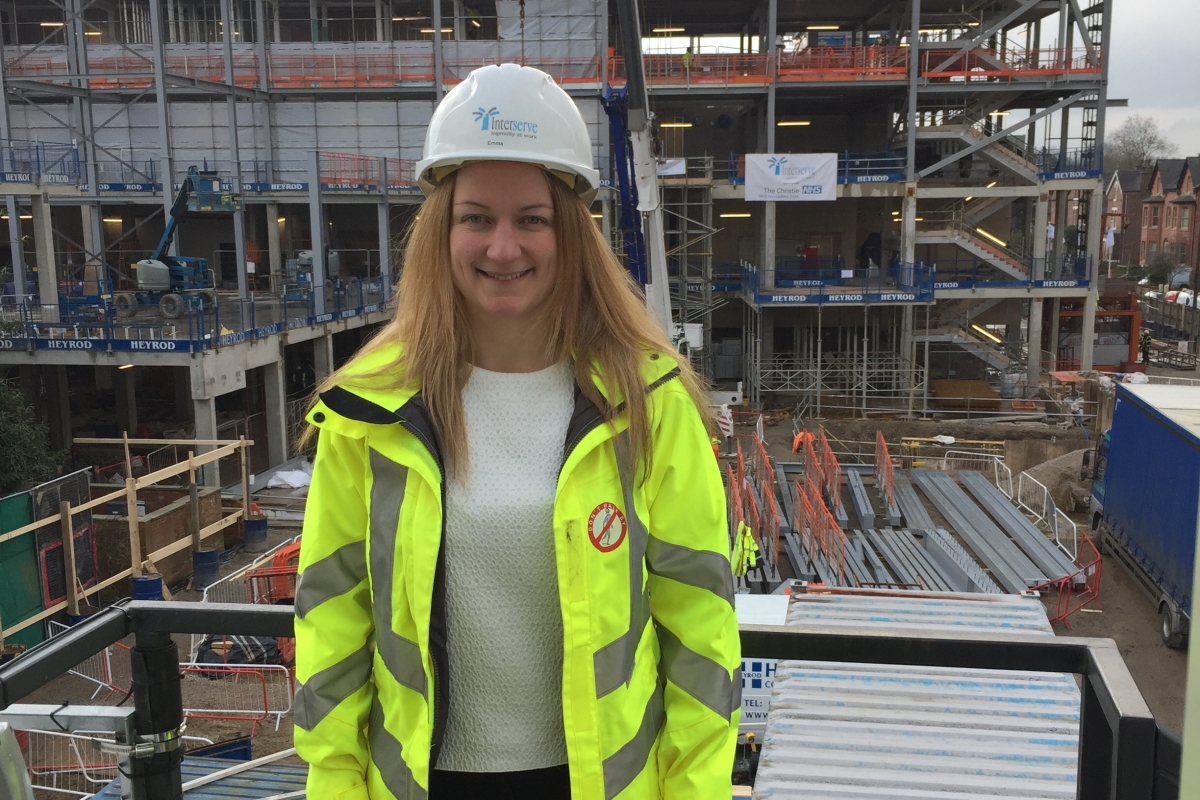
I never dreamt I would be working on the pioneering proton beam therapy project - Emma Hanrahan

Emma Hanrahan, assistant quantity surveyor for Interserve Construction delivering The Christie’s proton beam therapy centre

Emma Hanrahan
Interserve is working with The Christie to bring the UK's first high energy proton beam therapy service to Manchester. The state of the art five storey building will provide three treatment gantries, a research room, a patient reception, consultation rooms and public space.

As an assistant quantity surveyor I am responsible for the management, recording and reporting of the financial movement of elements of the construction project, as well as managing the subcontractors’ commercial progress on site.

After holding a long term job in the printing industry I decided that I wanted to retrain to do something I was really interested in and that maximised my strengths. I enrolled on a quantity surveying degree at Salford University in 2011 and secured my first position as a trainee quantity surveyor with Interserve two years later before graduating in 2015.

The construction industry starts early so I aim to get to site at 7.30am and leave at around 5pm. However, I must be reactive to issues when they arise, so these hours can stretch either end when necessary. I always start my day with a hot cup of tea whilst catching up on emails. My main role is to ensure that the project costs are being monitored correctly and cash flow is being met throughout the construction phase of a project. I’m also involved with the management of subcontractors working on the project, ensuring that they deliver to the right standard and are paid the correct amount for the work they complete. 

The best thing about my job is getting to work with great people and every single day being completely different and challenging. I enjoy seeing the progression of a site from start to finish and being able to say I helped to build that!

The highlight of the project for me to date was looking out of my site accommodation window to see Lucas, a five year old cancer patient, being presented with a gift of a John Deere toy tractor. It really struck me then why we’re doing this, it’s not just any other project; we’re delivering something that will make a difference!

Alongside my day job I’m involved with  fundraising for The Christie charity. Being onsite at The Christie I see the amazing care and treatment provided by the dedicated staff and I hope that our fundraising will help to create awareness and contribute to enabling this world class treatment to continue. I’m proud to say that in 2016 Interserve raised over £25,000 for the charity with plenty more planned for 2017, including a repeat of the highly successful ‘Come Dine with Me’ and our ‘legendary’ Wigan Race Night, as well as some new innovative fundraising initiatives including a stay in a haunted house and a motor bike ride from Land’s End to John O’Groats!

I never dreamt I would be working on the pioneering proton beam therapy project, which is scheduled to complete on time and within budget.  It’s such an inspirational place to work and I’m proud to be part of the team delivering a facility that will make such a huge difference to patient’s quality of life.

To learn more about careers in the construction industry and to visit our proton beam therapy site book your place on a tour at the end of this month at http://opendoors.construction/site/460

Monday, 27 February 2017

Cancer treatment closer to home - Vicki Burns

Vicki Burns, chemotherapy outreach manager at The Christie

Vicki Burns
February has been a busy month for the outreach chemotherapy service. This month we have opened a new nurse led chemotherapy clinic at Tameside Hospital. The clinic will be held in the new ‘Tameside Macmillan Unit’. 

This new unit has been provided through a joint partnership between Tameside and Glossop Integrated Care NHS Foundation Trust and Macmillan. Initially, Christie chemotherapy nurses will host a treatment clinic from the unit twice weekly, increasing to three clinics a week in April. The new clinic will provide the opportunity for around 60 Tameside patients per week to receive their cancer treatment locally.

The Tameside clinic is just one of the many developments that my team and I have been involved with over the last few years.

I have worked as a nurse at The Christie since 2003 and have been in my current role as outreach chemotherapy manager since 2013. During this time, I have seen many changes to the chemotherapy service as it has evolved to cope with an ever increasing demand.

An important change in the last four years has been the focus on enabling patients to access their anti-cancer therapies closer to their homes.

Historically, The Christie has successfully worked in partnership with five other hospital trusts in Greater Manchester and Cheshire to provide local chemotherapy clinics to Christie patients. These clinics have enabled hundreds of patients per year to receive their treatment in their local hospital.

In 2012, we developed a new chemotherapy strategy to build on the success of the local hospital clinics and to ensure that the chemotherapy service would meet the demands placed on it over the following three years. The strategy mapped out a network of local provision that would benefit many of our patients living across Greater Manchester.

With patient experience at the forefront of everyone’s minds, the team set up two Christie chemotherapy clinics at health centres in Greater Manchester, run entirely by our chemotherapy nurses. The clinics located in Bury and Ashton proved very popular with our patients and enabled us to treat around 30 patients a week closer to home; these are patients who would otherwise need to make the journey to the main Withington site. Just months later, a third clinic was set up at Salford Royal Hospital, with Christie nurses treating a further 12 patients per week.

The next bold step for the team was to develop a mobile chemotherapy service. Through the amazing work of fundraisers and BBC Radio Manchester, The Christie charity was able to purchase a bespoke chemotherapy mobile unit. Launched in 2013, the unit visits five different locations throughout the week, treating patients in Rochdale, Trafford, Hyde, Chadderton and Bolton. Staffed by our own specialist chemotherapy nurses we are able to treat around 70 patients per week on this unit. The unit has proved extremely popular with our patients and has received excellent feedback. Patients have said that having their treatment locally has reduced anxiety, saved them time and money and made their treatment visit feel ‘less clinical’.

In 2014, we opened ‘The Christie at Wigan’ treatment unit. A joint venture between Wigan Wrightington and Leigh NHS Foundation Trust and The Christie, it offers the opportunity for around 70 patients per week from the Wigan area to receive their cancer treatment locally.

By the end of the three year chemotherapy strategy we had reached our objective with 80% of clinically suitable chemotherapy treatments being administered locally to our patients. The team’s hard work gained recognition from the Quality in Care programme and we won a prestigious award for the impact our service had made on patient experience. We were also thrilled to make the shortlist for two awards from the Nursing Times and Health Service Journal.

In 2015, new objectives were set and we knew we had much work ahead to ensure that the service could support future projected increases in chemotherapy treatments.

In the summer of 2015, we launched ‘Christie at Home’ which takes our chemotherapy nurses out into the community and into our patients’ homes. Over the past 12 months, the team has gone from strength to strength, developing the service to cover the whole of Greater Manchester and Cheshire.

The service currently provides treatments for breast cancer patients, but over the next six months we plan to expand further to be able to administer more treatments to patients with other cancer types.
2017 brings with it many more exciting plans for our chemotherapy outreach service, with additional clinics to be set up at health centres and local blood testing clinics; I know this year will be yet another important one for the service.

Thanks to the hard work and dedication of all the chemotherapy team, the service has come such a long way in the last few years. We are on track to provide in excess of 18,000 chemotherapy treatments through our local clinics this year. Seeing the difference the service makes to our patients will always keep us moving forward. The outreach chemotherapy team is passionate about what we do and we are all so very proud and privileged to be in a position to make such a difference to our patients.

If patients are interested in finding out more about Christie chemotherapy services in the community, please contact the satellite chemotherapy outreach team on 0161 918 7654.

Monday, 20 February 2017

The results of the clinical trial I’m on for inflammatory breast cancer have been immense - Melanie O’Neill

Melanie O’Neill, Christie patient

Melanie O'Neill
Five and a half years ago, I began writing about my life with cancer.  With a following quickly growing in my local town, I began writing for my local paper’s website more and more regularly at www.warringtonguardian.co.uk

I was diagnosed with inflammatory breast cancer in May 2011 at Wigan hospital as I’d been previously misdiagnosed nine times elsewhere and my kids were only four and five then.

My symptoms were a red itchy patch of skin on my left breast, which was growing daily.  I had a constant dull ache there and I went up three bra cup sizes as it swelled rapidly. I knew something was wrong and over the last few months, having been told there was nothing wrong I started to google the symptoms myself.

One by one I was ticking off the ever increasing symptoms of inflammatory breast cancer, as they continued to get worse.  Thickening of the skin, inverted nipple, redness and swelling. It goes misdiagnosed and often found when it’s too late.  It does not show up on mammograms or ultrasound scans.

I was given a biopsy to get some answers, but that involved a three week wait. With all the symptoms being ticked off slowly but surely, the panic started to kick in.

When I went back to Wigan for the results they were inconclusive. So I was sent for an ultra sound and there the doctor diagnosed me with inflammatory breast cancer as it had now spread to my lymph nodes and the scan was able to show the spread.

My first emotion was relief. Someone was finally listening to me.  I wasn’t going mad. I wasn’t a hypochondriac. I had a name for what I had, but with only the knowledge of this “untreatable”, “when it’s found it’s too late” cancer that I had found from the internet.

Only days later I met Dr Gregory Wilson, who would then go on to be my oncologist for the foreseeable future.  He looked sincerely gutted when I told him how I had been let down previously. I started on chemotherapy just days later.

From the moment I met Dr Greg Wilson I knew he had compassion, something doctors aren’t trained in and very few see the importance of. After meeting my surgeon first, I was left wearing blood soaked bandages across my biopsied chest when I met my oncologist. When Greg pulled his chair up and took hold of both my hands, I felt cared for. I will never forget that moment and how precious that was to me when engulfed in fear and the increasingly suffocating, fretful emotions at that time.

Only a few weeks later I was at his clinic for my regular three-weekly check-ups where I was introduced to Julie Sexton, a complementary therapist for The Christie. Greg had arranged for her to set up a room in his clinic every Thursday, to help his patients in any way, to feel more relaxed.  And so I became friends with Julie who would massage my back or give reflexology whilst often drying my tears and putting the world to rights. It’s evident how much he cares for the wellbeing of his patients. I was also assigned a direct contact with Clare Gaskill my wonderful Macmillan nurse who is always there to help out when anything needs sorting.

Greg always had something else to offer whenever a chemo stopped working. In the midst of all this I took myself off to Brazil to see a spiritual healer, and a year later to a raw food institute to try and get better. I even took a second opinion from Dr Stephen Johnson from The Royal Marsden hospital in London. I always had faith in Dr Wilson but circumstance took me to London and instilled even more faith in him when Dr Johnson told me he would have made the exact same decisions as Dr Wilson.

Dr Wilson never stopped me from going or gave his opinion, and for that I will always be grateful along with, somehow, always having a plan for me. He even went above and beyond his call of duty when I asked him for his opinion on Kadcyla (chemotherapy) as I’d been asked by Roche, the manufacturers of many chemotherapies including Kadcyla, to do a presentation in Switzerland.  Even though he was away on holiday, he still helped me and my presentation awarding me a standing ovation.

Almost six years on from my initial diagnosis, I have now begun a clinical trial which has made an incredible improvement after just 1 dose.  It continues to work with minimal side effects for me, and I’m only on my third cycle. Oh I could write a book!  The clinical trial doctors, I have been assigned my own nurse, the ward… all amazing, including the results. Bonus!

With only a few months off here and there, I’ve been on chemotherapy almost continually for nearly six years, had two operations, light therapy, radiotherapy, and overall spent a ridiculous amount of money keeping well, taking supplements, homeopathy, massages etc. etc.  And then on top of all this

I was involved in a serious car accident where I suffered two brain bleeds and had to be taken by air ambulance to a brain trauma unit.

So I’ve had dealings with the psycho oncology team too. But the big man in the sky is not ready for me yet. Still holding on to hope. Still having faith that my cure is out there. I have every cell in my body believing in this clinical trial and so far…. it’s working. My kids don’t remember a time when I didn’t have cancer. I pray they’ll remember the day the doctors announce I’m in remission or ‘no evidence of disease’ as it’s known with inflammatory breast cancer. To be honest, I don’t care what it’s called as long as they can’t find it anymore.

To find out more about Clinical Trials at The Christie please visit www.christie.nhs.uk/professionals/research/clinical-trials or email Information.ClinicalTrials@christie.nhs.uk or speak to your consultant.